

色覚異常について
色覚異常とは
What is Color Vision Deficiency, CVD?
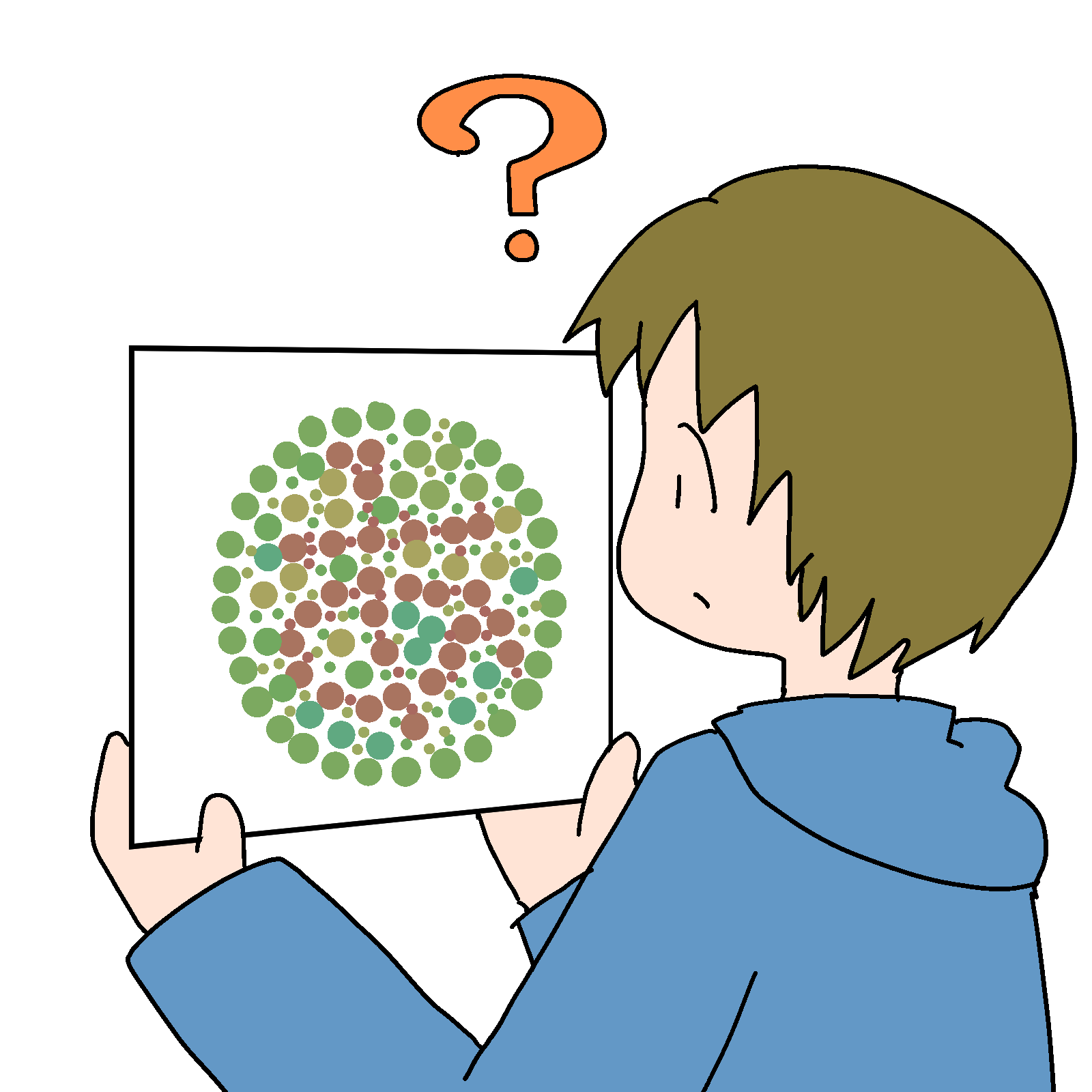
色覚異常(Color Vision Deficiency, CVD)とは
一般的に「色盲」や「色弱」とも呼ばれ、特定の色の識別や判別が難しい状態を指します。これは、網膜にある光を感じる細胞「錐体細胞(すいたいさいぼう)」の機能異常や欠損によって起こります。
Color Vision Deficiency (CVD)
Commonly referred to as "color blindness" or "color weakness," CVD is a condition in which it is difficult to identify or distinguish certain colors. This is caused by functional abnormalities or the absence of "cone cells," which are the light-sensing cells in the retina.
一般的に「色盲」や「色弱」とも呼ばれ、特定の色の識別や判別が難しい状態を指します。これは、網膜にある光を感じる細胞「錐体細胞(すいたいさいぼう)」の機能異常や欠損によって起こります。
Color Vision Deficiency (CVD)
Commonly referred to as "color blindness" or "color weakness," CVD is a condition in which it is difficult to identify or distinguish certain colors. This is caused by functional abnormalities or the absence of "cone cells," which are the light-sensing cells in the retina.
【どうして色が見えるの?】
How do we see colors?
目の中には、色を見つける「3人の光の担当者」がいます。
Inside our eyes, there are three "light scouts" who look for colors.
Inside our eyes, there are three "light scouts" who look for colors.
| 1 | 赤色担当のリーダー「 L錐体」(長波長錐体)Red Scout (The Leader): "L-cones" (Long-wavelength cones) |
| 2 | 緑色担当のメンバー「 M錐体」 (中波長錐体)Green Scout: "M-cones" (Medium-wavelength cones) |
| 3 | 青色担当のメンバー「 S錐体」(短波長錐体)Blue Scout: "S-cones" (Short-wavelength cones) |
この3人が「今は赤い光が強いよ!」「青い光も少し混ざっているよ!」と脳に報告します。すると脳がそれを混ぜ合わせて、いろいろな色を作り出してくれるのです。
These three scouts report to our brain, saying things like, "The red light is very strong right now!" or "There is a little bit of blue mixed in, too!". Our brain then mixes all that information together to create all the different colors we see.
These three scouts report to our brain, saying things like, "The red light is very strong right now!" or "There is a little bit of blue mixed in, too!". Our brain then mixes all that information together to create all the different colors we see.
【色の感じ方のちがい(色覚のタイプ)】
Differences in Color Perception (Types of Color Vision)
色の感じ方のちがい(色覚のタイプ)
人によって色の見え方はさまざまです。目は「錐体(すいたい)」という3つのセンサーで色を感じ取っていますが、そのセンサーの状態によっていくつかのタイプに分けられます。
Everyone sees colors a bit differently. Our eyes use three types of sensors called "cones" to perceive color. Depending on how these sensors function, color vision is categorized into several types.
人によって色の見え方はさまざまです。目は「錐体(すいたい)」という3つのセンサーで色を感じ取っていますが、そのセンサーの状態によっていくつかのタイプに分けられます。
Everyone sees colors a bit differently. Our eyes use three types of sensors called "cones" to perceive color. Depending on how these sensors function, color vision is categorized into several types.
| 分類 Category |
タイプの名称 Type |
どのセンサーが? Affected Cone |
見え方の特徴 Characteristics |
補足 Notes |
| 二色型 (1つお休み) Dichromacy (One missing) |
1型(P型) Type1(Protanopia) |
赤が苦手 Red |
赤・緑・茶の区別がつきにくい。明るさで判断することも。 Difficulty distinguishing Red, Green, and Brown. |
|
| 2型(D型) Type2(Deuteranopia) |
緑が苦手 Green |
赤と緑の区別がつきにくい。 Difficulty distinguishing Red and Green. |
1番多い Most common |
|
| 3型(T型) Type3(Tritanopia) |
青が苦手 Blue |
青と黄色の区別がつきにくい。 Difficulty distinguishing Blue and Yellow. |
非常に稀 Very rare |
|
| 異常三色型 (1つ弱い) Anomalous Trichromacy (One weak) |
1型(P型) Type1(Protanomaly) |
赤が弱い Red |
赤が暗く、くすんで見える。 Red colors appear darker and duller. |
|
| 2型(D型) Type2(Deuteranomaly) |
緑が弱い Green |
緑がくすんで見える。 Green colors appear duller. |
最も多い Most frequent |
|
| 3型(T型) Type3(Tritanomaly) |
青が弱い Blue |
青と黄色の区別がしづらいことがある。 Difficulty distinguishing Blue and Yellow. |
非常に稀 Very rare |
|
| 全色盲 (明るさで見る) Monochromacy (Focus on brightness) |
桿体一色性 Rod Monochromacy |
全て機能せず All non-functional |
色の識別ができず、明るさの違いで世界を見る。 See the world in shades of brightness; no color vision. |
まぶしさを感じやすい High light sensitivity |
| 錐体一色性 Cone Monochromacy |
1つだけ機能 Only one functional |
色の識別が非常に限られている。 Extremely limited color perception. |
非常に稀 Very rare |
【色覚異常の原因】
Causes of Color Vision Deficiency
色覚異常の主な原因は遺伝によるものです。特に赤緑色覚異常は、X染色体に関連する遺伝子の異常によって起こることが多く、男性に多く見られます。
女性はX染色体を2つ持っているため、片方のX染色体に異常があっても、もう片方の正常なX染色体が機能を補うことがあります。
後天的な色覚異常は、目の病気(網膜疾患、視神経疾患など)、外傷、薬の副作用などによって起こることがあります。
The primary cause of color vision deficiency is genetic factors. In particular, red-green color vision deficiency is linked to the X chromosome (X-linked inheritance), which is why it is predominantly observed in males.
Since females possess two X chromosomes, even if a mutation is present on one, the functional gene on the other X chromosome often compensates for it, making the condition less likely to manifest.
Acquired color vision deficiency, on the other hand, can be caused by ocular diseases (such as retinal or optic nerve disorders), physical trauma, or as a side effect of certain medications.
女性はX染色体を2つ持っているため、片方のX染色体に異常があっても、もう片方の正常なX染色体が機能を補うことがあります。
後天的な色覚異常は、目の病気(網膜疾患、視神経疾患など)、外傷、薬の副作用などによって起こることがあります。
The primary cause of color vision deficiency is genetic factors. In particular, red-green color vision deficiency is linked to the X chromosome (X-linked inheritance), which is why it is predominantly observed in males.
Since females possess two X chromosomes, even if a mutation is present on one, the functional gene on the other X chromosome often compensates for it, making the condition less likely to manifest.
Acquired color vision deficiency, on the other hand, can be caused by ocular diseases (such as retinal or optic nerve disorders), physical trauma, or as a side effect of certain medications.
【色覚異常の検査方法】
Methods of Color Vision Testing
| 検査名 Test Name |
内容 Methodology |
主な目的 Primary Purpose |
| 石原式検査表 Ishihara Test |
点で描かれた数字を読み取る Reading numbers or lines hidden within patterns of colored dots. |
初期スクリーニング(簡易検査) Initial screening for color vision deficiency. |
| アノマロスコープ Anomaloscope |
光の色を混ぜ合わせる Mixing light of specific wavelengths to match a reference color. |
精密な型判定・程度の診断 Detailed diagnosis of the type and severity of deficiency. |
| パネルD-15 Farnsworth Panel D-15 |
15個の色キャップを並べる Arranging 15 colored caps in order of hue. |
実生活や仕事への影響の評価 Evaluating the ability to discriminate colors in daily life or work. |
| ランタンテスト Lantern Test |
小さな色の光を見分ける Identifying the color of small, signal-like lights. |
職業適性の判断(信号の識別など) Determining vocational aptitude (e.g., aviation, maritime, or rail). |
【色覚特性を持つ人の生活と社会の歩み】
Life with Color Vision Variation and Social Progress
色覚特性(色の見え方の多様性)を持つ人は、色の感じ方が周囲と異なるため、日常生活で工夫を必要とする場面があります。
People with color vision variation (diversity in how colors are perceived) see colors differently from those around them, which may lead to situations where creative adjustments are needed in daily life.
1. 日常生活で直面しやすい課題
・色の識別: 衣類のコーディネート、食材の鮮度確認、路線図や地図の判別、信号機の色の見分けなど。
・職業の選択: 安全管理や精密な色判別が求められる職種(パイロット、電気工事士、一部のデザイン職など)では、採用条件に一定の基準が設けられている場合があります。
・教育現場: 教材のグラフの色分けが判別しにくい、理科の実験における薬品の変色反応が理解しにくいといったケースがあります。
1. Common Challenges in Daily Life
・Color Identification: Tasks such as coordinating outfits, checking the freshness of food, interpreting route maps or geographical maps, and distinguishing the colors of traffic signals.
・Career Choices: In professions where safety management or precise color discrimination is essential (e.g., pilots, electricians, and certain design roles), specific vision standards may be required as a condition of employment.
・Educational Settings: Instances where color-coded graphs in teaching materials are difficult to distinguish, or color changes in chemicals during science experiments are hard to interpret.
2. 社会における配慮と工夫(カラーユニバーサルデザイン)
現在、多くの場面で「誰にでも情報が伝わる工夫」が進んでいます。
・色の組み合わせ: 誰もが識別しやすい色の組み合わせ(コントラスト)を採用する。
・情報の多重化: 色だけでなく、文字・記号・模様を併記して情報を伝える。
・サポートツールの活用:
色覚補助レンズ: 特定の色の識別をサポートするメガネやコンタクトレンズ。
デジタル技術: スマホカメラで色名を読み上げるアプリや、色覚シミュレーションツールの活用。
2. Social Considerations and Innovations (Color Universal Design)
Currently, efforts to ensure that information is communicated clearly to everyone are advancing in many situations.
・Color Combinations: Using color schemes (contrast) that are easy for anyone to distinguish.
・Redundancy of Information: Conveying information not just through color, but also by including text, symbols, and patterns.
・Use of Support Tools:
Color Vision Correction Lenses: Glasses or contact lenses that help identify specific colors.
Digital Technology: Using smartphone apps that read out color names through the camera, or color vision simulation tools.
People with color vision variation (diversity in how colors are perceived) see colors differently from those around them, which may lead to situations where creative adjustments are needed in daily life.
1. 日常生活で直面しやすい課題
・色の識別: 衣類のコーディネート、食材の鮮度確認、路線図や地図の判別、信号機の色の見分けなど。
・職業の選択: 安全管理や精密な色判別が求められる職種(パイロット、電気工事士、一部のデザイン職など)では、採用条件に一定の基準が設けられている場合があります。
・教育現場: 教材のグラフの色分けが判別しにくい、理科の実験における薬品の変色反応が理解しにくいといったケースがあります。
1. Common Challenges in Daily Life
・Color Identification: Tasks such as coordinating outfits, checking the freshness of food, interpreting route maps or geographical maps, and distinguishing the colors of traffic signals.
・Career Choices: In professions where safety management or precise color discrimination is essential (e.g., pilots, electricians, and certain design roles), specific vision standards may be required as a condition of employment.
・Educational Settings: Instances where color-coded graphs in teaching materials are difficult to distinguish, or color changes in chemicals during science experiments are hard to interpret.
2. 社会における配慮と工夫(カラーユニバーサルデザイン)
現在、多くの場面で「誰にでも情報が伝わる工夫」が進んでいます。
・色の組み合わせ: 誰もが識別しやすい色の組み合わせ(コントラスト)を採用する。
・情報の多重化: 色だけでなく、文字・記号・模様を併記して情報を伝える。
・サポートツールの活用:
色覚補助レンズ: 特定の色の識別をサポートするメガネやコンタクトレンズ。
デジタル技術: スマホカメラで色名を読み上げるアプリや、色覚シミュレーションツールの活用。
2. Social Considerations and Innovations (Color Universal Design)
Currently, efforts to ensure that information is communicated clearly to everyone are advancing in many situations.
・Color Combinations: Using color schemes (contrast) that are easy for anyone to distinguish.
・Redundancy of Information: Conveying information not just through color, but also by including text, symbols, and patterns.
・Use of Support Tools:
Color Vision Correction Lenses: Glasses or contact lenses that help identify specific colors.
Digital Technology: Using smartphone apps that read out color names through the camera, or color vision simulation tools.
【色覚異常についてのご案内】
Information on Color Vision Deficiency
色覚異常はひとつの特性であり、周囲の理解と適切な環境設定があれば、日常生活において過度な心配は必要ありません。早期に自身の特性を正しく認識し、必要に応じたサポートを受けることで、不自由なく社会生活を送ることが可能です。
ご自身やご家族の見え方について気になる点がございましたら、眼科受診による専門的な検査をご検討ください。
客観的な診断を受けることが、生活の質(QOL)を向上させる重要な手がかりとなります。
些細な疑問でも、どうぞお気軽にお尋ねください。
Color vision deficiency is a personal trait, and in most cases, it does not pose a significant obstacle to daily life with proper understanding and environmental adjustments. By recognizing one's specific characteristics early on and accessing appropriate support, it is entirely possible to lead a social life without unnecessary restrictions.
If you or a family member notice any differences in how colors are perceived, we recommend consulting an ophthalmologist for a professional examination. Receiving an accurate diagnosis is a vital first step toward improving your quality of life (QOL).
Please feel free to contact us with any questions or concerns, no matter how small.
ご自身やご家族の見え方について気になる点がございましたら、眼科受診による専門的な検査をご検討ください。
客観的な診断を受けることが、生活の質(QOL)を向上させる重要な手がかりとなります。
些細な疑問でも、どうぞお気軽にお尋ねください。
Color vision deficiency is a personal trait, and in most cases, it does not pose a significant obstacle to daily life with proper understanding and environmental adjustments. By recognizing one's specific characteristics early on and accessing appropriate support, it is entirely possible to lead a social life without unnecessary restrictions.
If you or a family member notice any differences in how colors are perceived, we recommend consulting an ophthalmologist for a professional examination. Receiving an accurate diagnosis is a vital first step toward improving your quality of life (QOL).
Please feel free to contact us with any questions or concerns, no matter how small.